
The Singapore Test
Reindustrialisation needs a measurable objective to be credible


As Andy Burnham prepares for his Premiership, Labour policy wonks have been hurling themselves towards him in the hope he will take up their cause. Burnham himself has historically been so adaptable to political fashions that everyone outside of the Tories and Reform thinks they can curry his favour. The Manchester messiah’s people-pleasing instincts are so well known that even stilted Starmer can crack a good joke on the subject.
Burnham professes to be very interested in ‘reindustrialisation’, with a particular focus on the North. It is, of course, worth noting that British industry was never monopolised by the North. The South East has more manufacturing value added than Yorkshire and the Humber, and over double that of Wales. Deindustrialisation has been a national phenomenon, dragging down local economies across the board.
The details on reindustrialisation are limited, to say the least, with its description extending beyond manufacturing and production to include services. One does not get the sense that Burnham is particularly focused on market shares for advanced aerospace equipment, car production volumes, refinery capacity or the degrading capital stock in plant equipment and machinery. Rather, he is interested in reindustrialisation in so far as it alludes to a politics of place, devolution and a general preference for the left-behind regions over the prosperous South. The concern here is that reindustrialisation is little more than signalling detached from any serious look at the makeup of the British economy. While thinkers like Larry Elliot are trying to articulate reindustrialisation in more detail, I am not sure how influential they are with Burnham’s team.
While I am far from a Labour Party insider, I am told that the supporters of reindustrialisation are struggling to find purchase, while Ed Miliband’s team and Jim O’Neill are getting much more traction. O’Neill, much like former head of the Resolution Foundation and current MP Torsten Bell, is relaxed about Britain specialising further in services, while Ed Miliband’s Net Zero agenda is just downright hostile to the production sector. Miliband ally Miatta Fahnbulleh is tipped to be a major author of Burnham’s policy agenda. One of her alleged proposals is a rising block tariff for energy, where the tariff rate increases the more a consumer spends. This would essentially punish heavy energy users in favour of poor households, though I imagine this relates specifically to household electricity usage. Burnham looks set to be a version of Manchesterism plus Net Zero. The chances of this benefiting industry are, I think, rather small.
Many will respond that industry is a small share of the economy and shouldn’t be prioritised anyway. The obvious counter is that the jobs are high-productivity per worker and disproportionately important for exports and R&D expenditure. It’s also the case that having no hardware production capacity will eventually eat into your capacity to innovate in software. As Andrew Sabisky points out, hardware production is becoming increasingly intertwined with software production.
It is worth noting that the manufacturing sector is not that small: it is about £200 billion in value. If we added agriculture, mining and quarrying, the larger production economy would be £334 billion. Interestingly, the loss of North Sea extraction has seen GVA for mining fall from £166 billion in 1999 to £27 billion today, with the shortfall not offset by modest gains in manufacturing revenue. If we combined agriculture, manufacturing, extraction and construction, we would have a production economy with a value of £485 billion in 2025, or 19% of total GVA. Alarmingly, this sector reached its high point of £504 billion (£2025 money) in 2006. Having your capacity to manufacture, build, and produce energy and food stagnate for 20 years is probably not fine.
These sectors are of significant importance not just for the exchequer, but as load-bearing sectors necessary to stimulate growth in services. The ability to produce food and build infrastructure at scale is more important than GVA numbers would first imply.
Reindustrialisation is going to be hard. At this nascent stage, I think the most important thing is to actually quantify what it would mean. It is here where Burnham’s current rhetoric falls flat. There just isn’t much clarity on what successful reindustrialisation would look like in terms of GVA share or growth. Inspiration, I think, can be found in an unlikely Southeast Asian source: Singapore.
In this tropical paradise, the government owns the vast bulk of housing, and there is a fair bit of social engineering when it comes to demographics. The fact that manufacturing is 20% of Singapore’s economy (versus 8% for Britain) puts paid to the idea that a metropolitan economy with a large financial sector will inherently deindustrialise.
Singapore, alongside South Korea, stands out for having an incredibly high density of robots. Singapore has 0.8 robots for every 10 manufacturing workers, while Britain had 0.12 robots for every 10 workers, below the world average of 0.13. At least part of the explanation for this difference in capital stock is Singapore’s generous use of government grants; in Singapore, this includes the Productivity Solutions Grant (PSG) and Enterprise Development Grants (EDGs). While the PSG offers grants for small companies to buy established technologies, the EDG provides funding for more transformative projects. The eligibility criteria for these grants include a minimum domestic ownership threshold of 30%. Singapore’s largest manufacturer, ST Engineering, is majority-owned by the country’s sovereign wealth fund Temasek.
Beyond having a lot of policy interventions, Singapore also has an explicit policy target for manufacturing to be around 20% of GDP, and for manufacturing value added to grow 50% between 2020 and 2030 in real terms. For context, UK manufacturing value added grew 12% between 2015 and 2025 in real terms, so the target is ambitious.
For any political project to propose reindustrialisation and be taken seriously, there should be a basic “Singapore” test, focused on two criteria:
There should be an explicit growth target. For Britain, I recommend a 10-year minimum target for the value-added growth in manufacturing of at least 50%. Assuming this starts in 2025, Britain in 2035 would have a manufacturing GVA of nearly £350 billion, over £100 billion more than today. As we can see in Figure 1, it would have a dramatic impact. However, it would not be a target outside of recent historical precedent. From 1996 to 2006, British manufacturing value actually increased by 52%.
There should be a target for the share of the economy we want manufacturing and production to represent. Assuming a 50% increase in real manufacturing value and the whole British economy growing at 2% per annum up to 2035, manufacturing would grow to 10% of GVA, up from 8% today. Under a more realistic 1% annual growth scenario, it would grow to 11% of GVA.
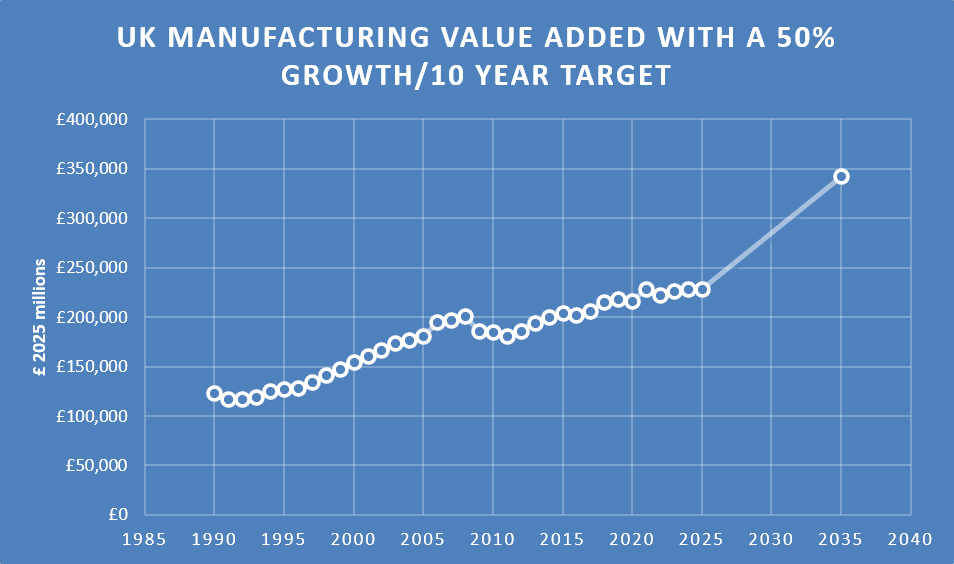
Figure 1: UK manufacturing GVA with a 50% growth target between 2025 and 2035. Source: ONS GDP Low Level Aggregates.
It is important, then, that reindustrialists do not oversell their project. We are not projecting a revolution in political economy (at least for the first term). We are setting an ambitious 10-year target to see manufacturing return to growth and rise as a share of GDP, more in line with Europe and America.
This rejuvenation should improve Britain’s international competitiveness and increase investment in new manufacturing start-ups, which will hopefully lead to the establishment of British manufacturing conglomerates that can invest at scale and compete globally. If we can time this uptick with significantly reduced energy costs from 2035 onwards, we can lay the foundations for a much more capable British industrial economy than we currently have.